Photonenhaushalt: Eine technische Analyse der GRAVITY-Serie für die Meerwasseraquaristik
Magazin
9. Fazit
Eine Reef-LED lässt sich an vier Fragen prüfen: Landet die Energie im photobiologisch richtigen Fenster, landet sie an der richtigen Stelle im Becken, kommt sie dort bereits gemischt an, und bleibt das alles über die Lebensdauer der Leuchte stabil? Für die GRAVITY-Serie lässt sich das anhand offen dokumentierter Messdaten beantworten: rund 81 % des Photonenflusses im PUR-relevanten Bereich zwischen 400 und 500 nm, konstant über fünf Baugrößen; eine Optik, die Flächenabdeckung und Tiefenwirkung im selben Cluster kombiniert, statt Farben erst im Wasser mischen zu lassen; eine mechanische Auslegung, die eher an Laborgeräte als an klassische Aquarienbeleuchtung erinnert; und eine vakuumlaminierte, passiv gekühlte Bauweise mit einer Lebensdauererwartung von über 50.000 Stunden, die genau diese Spektralform auch nach Jahren im Salzwasserbetrieb stabil hält.
Was das nicht ersetzt, ist Sachkenntnis am Becken selbst. Kein Spektrum rettet eine Trachyphyllia, die unter 400 PAR liegt, und keine Optik gleicht aus, wenn die eigentliche Frage – wie viel Licht kommt an dieser Position tatsächlich an – nie gestellt wurde. Dafür braucht es Werkzeuge wie LiST, die aus einer Leuchte ein Setup machen, und eine Denkweise, die eine große Leuchte nicht automatisch für die bessere hält. Das Riff selbst hat diese Rechnung schon vor einigen hunderttausend Jahren gelöst; die Technik muss ihr nur noch folgen.
GRAVITY 21, zwei LED-Cluster, 30 W Systemleistung – die kompakteste Einheit der Serie. Quelle: b-spx.com.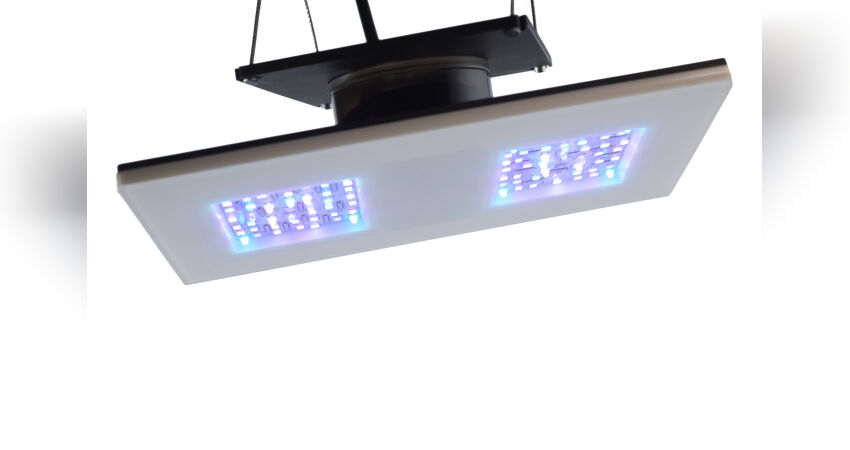
GRAVITY
Fünf Kanäle - Definierte Photonen - Keine Kompromisse
- Licht kommt bereits gemischt aus dem Cluster – nicht erst irgendwo oder auch nicht...
- 81 % des Lichts im PUR-Kernfenster 400–500 nm – über alle fünf Baugrößen hinweg
- CRI 97 im Weiß, 99,3 % / 99,6 % Reinheit in Royal Blue und Actinic – spektral kompromisslos
- Cyan-Orange-Pink-Kanal speziell für die Farbtiefe von LPS-Favoriten wie Euphyllia und Trachyphyllia
- 120°-Flächenoptik + 60°-Tiefenoptik in jedem Cluster – kein Cyan-Gap, kein Hotspot
- IP69, lüfterlos, vakuumlaminiert, 10 mm Bauhöhe – endlose Installationsmöglichkeiten
- Light Scaping statt Blindflug – mit LiST kostenlos planbar
- Wächst mit Deinem Becken – Module jederzeit neu positionieren, neigen und mit LiST neu planen
30 bis 180 Watt. Ein System. Skalierbar für jedes Becken.
Mehr unter b-spx.com — GRAVITY jetzt erhältlich für Dein Becken

Quellenverzeichnis
Die hochgestellten Zahlen im Fließtext sind Fußnoten und finden sich als solche am Ende der jeweiligen Seite. Da mehrere Fußnoten teils auf dieselbe Quelle verweisen, ist die folgende Liste dedupliziert und durchnummeriert; in Klammern steht jeweils, unter welcher/welchen Fußnotenzahl(en) die Quelle im Fließtext zitiert wird.
1. Wikipedia: Peridinin (Fußnote 1) – https://en.wikipedia.org/wiki/Peridinin
2. Jimenez, I. M., Larkum, A. W. D., Ralph, P. J. et al. (2012) (Fußnote 2) – https://www.mbl.ku.dk/mkuhl/pages/PDF/Jimenez%20et%20al%202012b.pdf
3. Larkum, A., Wangpraseurt, D., Kühl, M., Ralph, P. (2012), Frontiers in Microbiology (Fußnote 3) – https://pmc.ncbi.nlm.nih.gov/articles/PMC3427877/
4. D'Angelo, C., Tchernov, D., Smith, E. G., Wiedenmann, J., Sharon, Y. (2017), Proceedings of the Royal Society B (Fußnote 4) – https://royalsocietypublishing.org/doi/10.1098/rspb.2017.0320
5. Toller, W., Rowan, R., Knowlton, N. (2001), The Biological Bulletin (Fußnote 31) – https://www.journals.uchicago.edu/doi/10.2307/1543613
6. Mendes, C. et al. (2017), International Journal of Aquaculture (Fußnote 25) – http://biopublisher.ca/index.php/ija/article/view/3069
7. Reef Builders (2026): GRAVITY by B-SPX (Fußnoten 6, 35, 37, 40) – https://reefbuilders.com/2026/08/04/gravity-by-b-spx-inside-the-mother-of-all-leds-live-qa-today/
8. ph-aquaristik.de: GRAVITY Technikdatenblätter (Fußnoten 5, 7, 8, 29, 30, 32, 33, 36) – https://ph-aquaristik.de/Technik/
9. b-spx.com: GRAVITY Produktübersicht (Fußnote 9) – https://b-spx.com/en/collections/gravity
10. b-spx.com: LiST Light Scaping Tool (Fußnote 34) – https://b-spx.com/en/pages/list
11. Tidal Gardens: Trachyphyllia Care (Fußnote 21) – https://tidalgardens.com/articles/coral-care-articles/trachyphyllia-coral-care.html
12. Meta Reef: Trachyphyllia (Fußnote 22) – https://metareef.com/corals/trachyphyllia
13. ReefBay: Xenia Coral Care Guide (Fußnote 23) – https://reefbay.com/guides/complete-xenia-coral-care-guide-the-pulsing-soft-coral
14. Saggese-Hayden (2022), BGSU: Effect of Light Intensity on Euphyllia Coral (Fußnote 24) – https://blogs.bgsu.edu/theteachingprofessor/files/2023/07/FALL-2022-saggesehayden_Saggese-2022-Euphyllia-PAR.pdf
15. Reefco Aquariums: PAR Levels for Corals (Fußnote 26) – https://reefcoaquariums.com/blogs/news/par-levels-for-corals-sps-lps-soft-corals
16. Riuttareef: LPS, SPS and Soft Corals in Practice (Fußnote 27) – https://riuttareef.com/en/articles/coral-groups-practice/
17. Reef Pedia: The Best PAR for Coral (Fußnote 28) – https://reefpedia.org/en/the-best-par-for-coral-how-to-choose-it/
18. EcoTech Marine: Radion Bedienungsanleitung (Montagehöhe, Kühlung) (Fußnote 38) – http://ecotechmarine.com/wp-content/downloads/XR1530_QSG_GERMAN_Web.pdf
19. Bulk Reef Supply: BRStv Investigates Light Position (Fußnote 39) – https://www.bulkreefsupply.com/content/post/brstv-investigates-light-position
20. Universität Oldenburg (ICBM): SciReef erhält EXIST-Gründungsförderung (Fußnote 41) – https://uol.de/en/icbm/news-events/article/coral-researchers-awarded-exist-start-up-funding-8861
21. B-SPX (YouTube): „Aquarienlicht neu gedacht – Stefan von B-SPX über die neue Gravity“ (Fußnote 42) – https://www.youtube.com/watch?v=ORMJSpu5zD8
22. Coralaxy on Tour (YouTube): „SciReef – Coral Breeding 2.0“ (Fußnote 43) – https://www.youtube.com/watch?v=j4XP179Lz9Y
23. NOAA Science On a Sphere: ClimateBits – Solar Radiation (Fußnoten 10, 16) – https://sos.noaa.gov/catalog/datasets/climatebits-solar-radiation/
24. World Health Organization: Ultraviolet (UV) radiation – Q&A (Fußnoten 11, 17) – https://www.who.int/news-room/questions-and-answers/item/radiation-ultraviolet-(uv)
25. Overmans, S., Agustí, S. (2019): Latitudinal Gradient of UV Attenuation Along the Highly Transparent Red Sea Basin, Photochemistry and Photobiology 95(5) (Fußnoten 12, 18) – https://pmc.ncbi.nlm.nih.gov/articles/PMC6852308/
26. Barron, M. G., Vivian, D. N., Yee, S. H., Santavy, D. L. (2009): Methods to estimate solar radiation dosimetry in coral reefs, Environmental Monitoring and Assessment 151 (Fußnoten 13, 19) – https://pubmed.ncbi.nlm.nih.gov/18581248/
27. Bollati, E., Plimmer, D., D’Angelo, C., Wiedenmann, J. (2017): FRET-Mediated Long-Range Wavelength Transformation by Photoconvertible Fluorescent Proteins, International Journal of Molecular Sciences 18(7) (Fußnote 14) – https://pubmed.ncbi.nlm.nih.gov/28677653/
28. Singh, A., Čížková, M., Bišová, K., Vítová, M. (2021): Exploring Mycosporine-Like Amino Acids (MAAs), Antioxidants 10(5) (Fußnote 15) – https://pmc.ncbi.nlm.nih.gov/articles/PMC8145676/
29. ISO 21348:2007 – Definitions of Solar Irradiance Spectral Categories (Fußnote 20) – https://www.iso.org/standard/39911.html
Wikipedia: Peridinin. https://en.wikipedia.org/wiki/Peridinin↩︎
Jimenez, I. M., Larkum, A. W. D., Ralph, P. J. et al. (2012). https://www.mbl.ku.dk/mkuhl/pages/PDF/Jimenez%20et%20al%202012b.pdf↩︎
Larkum, A., Wangpraseurt, D., Kühl, M., Ralph, P. (2012), Frontiers in Microbiology. https://pmc.ncbi.nlm.nih.gov/articles/PMC3427877/↩︎
D'Angelo, C., Tchernov, D., Smith, E. G., Wiedenmann, J., Sharon, Y. (2017), Proceedings of the Royal Society B. https://royalsocietypublishing.org/doi/10.1098/rspb.2017.0320↩︎
ph-aquaristik.de, GRAVITY-Datenblätter. https://ph-aquaristik.de/Technik/↩︎
Reef Builders (2026): GRAVITY by B-SPX – Inside the Mother of All LEDs. https://reefbuilders.com/2026/08/04/gravity-by-b-spx-inside-the-mother-of-all-leds-live-qa-today/↩︎
ph-aquaristik.de. https://ph-aquaristik.de/Technik/↩︎
ph-aquaristik.de. https://ph-aquaristik.de/Technik/↩︎
b-spx.com/en/collections/gravity. https://b-spx.com/en/collections/gravity↩︎
NOAA Science On a Sphere: ClimateBits – Solar Radiation (rund 7 % des Sonnenlichts an der Erdoberfläche ist UV). https://sos.noaa.gov/catalog/datasets/climatebits-solar-radiation/↩︎
World Health Organization: Ultraviolet (UV) radiation – Q&A (UV-A macht über 95 % der UV-Strahlung an der Erdoberfläche aus). https://www.who.int/news-room/questions-and-answers/item/radiation-ultraviolet-(uv)↩︎
Overmans, S., Agustí, S. (2019): Latitudinal Gradient of UV Attenuation Along the Highly Transparent Red Sea Basin, Photochemistry and Photobiology 95(5), 1267–1279. https://pmc.ncbi.nlm.nih.gov/articles/PMC6852308/↩︎
Barron, M. G., Vivian, D. N., Yee, S. H., Santavy, D. L. (2009): Methods to estimate solar radiation dosimetry in coral reefs, Environmental Monitoring and Assessment 151, 445–455. https://pubmed.ncbi.nlm.nih.gov/18581248/↩︎
Bollati, E., Plimmer, D., D’Angelo, C., Wiedenmann, J. (2017): FRET-Mediated Long-Range Wavelength Transformation by Photoconvertible Fluorescent Proteins as an Efficient Mechanism to Generate Orange-Red Light in Symbiotic Deep Water Corals, International Journal of Molecular Sciences 18(7), 1174. https://pubmed.ncbi.nlm.nih.gov/28677653/↩︎
Singh, A., Čížková, M., Bišová, K., Vítová, M. (2021): Exploring Mycosporine-Like Amino Acids (MAAs) as Safe and Natural Protective Agents against UV-Induced Skin Damage, Antioxidants 10(5). https://pmc.ncbi.nlm.nih.gov/articles/PMC8145676/↩︎
NOAA Science On a Sphere: ClimateBits – Solar Radiation (rund 7 % des Sonnenlichts an der Erdoberfläche ist UV). https://sos.noaa.gov/catalog/datasets/climatebits-solar-radiation/↩︎
World Health Organization: Ultraviolet (UV) radiation – Q&A (UV-A macht über 95 % der UV-Strahlung an der Erdoberfläche aus). https://www.who.int/news-room/questions-and-answers/item/radiation-ultraviolet-(uv)↩︎
Overmans, S., Agustí, S. (2019): Latitudinal Gradient of UV Attenuation Along the Highly Transparent Red Sea Basin, Photochemistry and Photobiology 95(5), 1267–1279. https://pmc.ncbi.nlm.nih.gov/articles/PMC6852308/↩︎
Barron, M. G., Vivian, D. N., Yee, S. H., Santavy, D. L. (2009): Methods to estimate solar radiation dosimetry in coral reefs, Environmental Monitoring and Assessment 151, 445–455. https://pubmed.ncbi.nlm.nih.gov/18581248/↩︎
ISO 21348:2007 – Definitions of Solar Irradiance Spectral Categories. https://www.iso.org/standard/39911.html↩︎
Tidal Gardens: Trachyphyllia Care. https://tidalgardens.com/articles/coral-care-articles/trachyphyllia-coral-care.html↩︎
Meta Reef: Trachyphyllia. https://metareef.com/corals/trachyphyllia↩︎
ReefBay: Complete Xenia Coral Care Guide. https://reefbay.com/guides/complete-xenia-coral-care-guide-the-pulsing-soft-coral↩︎
Saggese-Hayden (2022), BGSU-Studie zu Euphyllia. https://blogs.bgsu.edu/theteachingprofessor/files/2023/07/FALL-2022-saggesehayden_Saggese-2022-Euphyllia-PAR.pdf↩︎
Mendes, C. et al. (2017), International Journal of Aquaculture. http://biopublisher.ca/index.php/ija/article/view/3069↩︎
Reefco Aquariums: PAR Levels for Corals. https://reefcoaquariums.com/blogs/news/par-levels-for-corals-sps-lps-soft-corals↩︎
Riuttareef: Coral Groups in Practice. https://riuttareef.com/en/articles/coral-groups-practice/↩︎
Reef Pedia: The Best PAR for Coral. https://reefpedia.org/en/the-best-par-for-coral-how-to-choose-it/↩︎
b-spx.com (via ph-aquaristik.de). https://ph-aquaristik.de/Technik/↩︎
b-spx.com (via ph-aquaristik.de). https://ph-aquaristik.de/Technik/↩︎
Toller, W., Rowan, R., Knowlton, N. (2001), The Biological Bulletin. https://www.journals.uchicago.edu/doi/10.2307/1543613↩︎
ph-aquaristik.de. https://ph-aquaristik.de/Technik/↩︎
ph-aquaristik.de, GRAVITY-Technikdatenblätter. https://ph-aquaristik.de/Technik/↩︎
b-spx.com/en/pages/list – LiST Light Scaping Tool. https://b-spx.com/en/pages/list↩︎
Reef Builders (2026): GRAVITY by B-SPX – Inside the Mother of All LEDs. https://reefbuilders.com/2026/08/04/gravity-by-b-spx-inside-the-mother-of-all-leds-live-qa-today/↩︎
ph-aquaristik.de. https://ph-aquaristik.de/Technik/↩︎
Reef Builders (2026): GRAVITY by B-SPX – Inside the Mother of All LEDs. https://reefbuilders.com/2026/08/04/gravity-by-b-spx-inside-the-mother-of-all-leds-live-qa-today/↩︎
EcoTech Marine: Radion Bedienungsanleitung (Montagehöhe, Kühlung). http://ecotechmarine.com/wp-content/downloads/XR1530_QSG_GERMAN_Web.pdf↩︎
Bulk Reef Supply: BRStv Investigates Light Position. https://www.bulkreefsupply.com/content/post/brstv-investigates-light-position↩︎
Reef Builders (2026): GRAVITY by B-SPX – Inside the Mother of All LEDs. https://reefbuilders.com/2026/08/04/gravity-by-b-spx-inside-the-mother-of-all-leds-live-qa-today/↩︎
Universität Oldenburg (ICBM): SciReef erhält EXIST-Gründungsförderung. https://uol.de/en/icbm/news-events/article/coral-researchers-awarded-exist-start-up-funding-8861↩︎
B-SPX (YouTube): „Aquarienlicht neu gedacht – Stefan von B-SPX über die neue Gravity“. https://www.youtube.com/watch?v=ORMJSpu5zD8↩︎
Coralaxy on Tour (YouTube): „SciReef – Coral Breeding 2.0“. https://www.youtube.com/watch?v=j4XP179Lz9Y↩︎


Wie gefällt Ihnen dieser Artikel?
Infos
Autor

Lesezeichen
Kommentare
Themen
Ähnliche Artikel
- Pressemeldung: Das Pulzar G3 LED Modul von Giesemann
- Orphek , die Diode macht den Unterschied
- Fauna Marin Star Fire T5 Hängeleuchten
- Importstop Indonesien und der Umgang des Handels mit Korallenablegern
- Wie ein Meerwasseraquarium entsteht Teil 38: Wenn Korallen sich vernesseln, Kampf um Siedlungsraum
- 9 Teil: Langzeittest T5 Röhren
- Indonesien öffnet wieder für Korallenexporte
- Mondlicht im Aquarium II
- Pacific Sun LED Aquarium Lighting
- Überlegungen zum Thema Licht für die Meerwasseraquaristik
Kommentare Zum Anfang
Bitte anmelden
Damit Sie selbst etwas schreiben können, müssen Sie sich vorher anmelden.